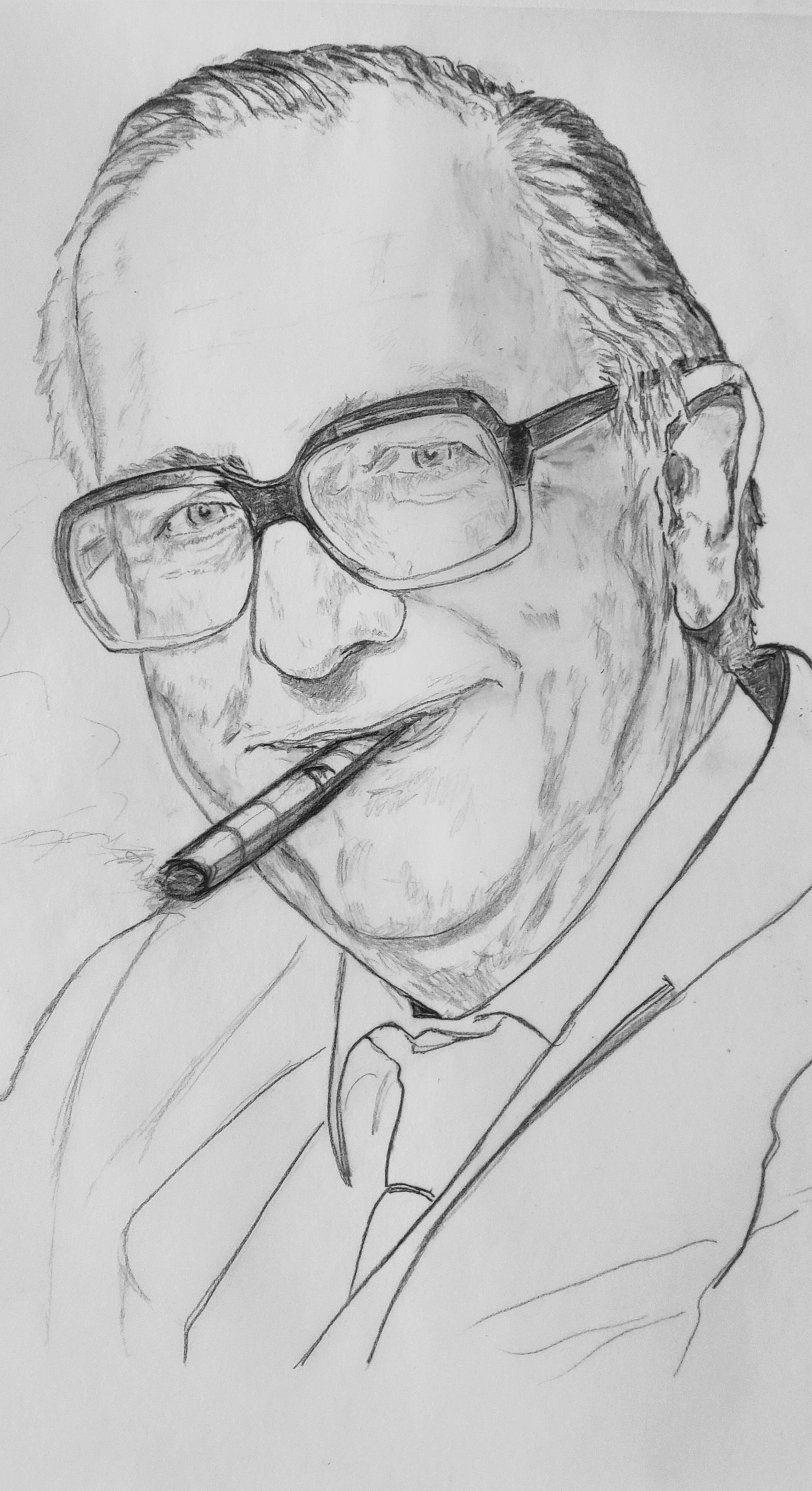
Portrait of Tom Sharpe
Tom Sharpe · pencil drawing by B. Jeanson-Beteille

Author’s note

A life’s worth of decades on Earth, or simply the time of disillusionment?

Right at the centre of his own gravity, Tom Sharpe shifts from teacher to writer. Forty-two years of slow maturation (that odd little number again…).

A strong drink against apartheid, which earns him prison and then expulsion back to his homeland. From the dark South African years to the misty Midlands of 1970s England, he keeps firing satirical volleys. The brazenness of the mediocre fascinates him. The alienation of the individual drives him furious.

Sharpe shoots in all directions: codes and etiquette that tape you down exactly where you never wanted to be. The half-century that separates us from the first volume of the Wilt series is one of those that bring us closer. Sideburns and flared trousers may have fallen away; oppressions, on the other hand, cling on. Nothing really changes.

So don’t trust the face or the vague “has-been” impression. This is a writer who feels contemporary in every age. Even in those still to come.

Beaumarchais hurried to laugh at everything, for fear of being obliged to weep. Tom Sharpe chose the same pair of glasses. Put them on as well: they help you see more clearly. Better still, they help you find a way through.

A pity my ophthalmologist doesn’t prescribe that model… — TNoC

Bio · Strates de vie

Enfance & formation

Né à Londres dans une famille de classe moyenne, Sharpe grandit entre un père pasteur anglican aux convictions politiques tranchées et une Angleterre d’avant-guerre qui bascule rapidement dans les bouleversements du XXe siècle. Après la scolarité, il passe par les Royal Marines puis étudie l’histoire et l’anthropologie sociale à Cambridge.

Afrique du Sud : satire et rupture

Dans les années 1950-1960, il part travailler en Afrique du Sud comme assistant social et employé dans des institutions liées au régime d’apartheid. Il y découvre de l’intérieur la brutalité bureaucratique du système, s’en moque dans des pièces satiriques, est arrêté puis expulsé. Cet épisode devient l’un des grands réservoirs de rage et de matériau pour ses premiers romans.

Retour en Angleterre & métier d’écrivain

De retour au Royaume-Uni, il enseigne dans un technical college des Midlands – un étage en dessous de l’université prestigieuse – tout en écrivant. C’est de ce poste un peu marginal que naîtront les premiers livres qui le rendent célèbre, jusqu’au succès de la série Wilt et des satires académiques et policières qui l’installent comme romancier à plein temps.

Exil catalan & dernière période

La fin de sa vie se déroule en Catalogne, à Llafranc, dans une semi-retraite active : routine d’écriture, promenades, visites d’amis. Loin de l’Angleterre mais obsédé par elle, il continue d’y situer ses farces institutionnelles. Les problèmes de santé se multiplient, plusieurs projets restent inachevés, mais l’essentiel de l’œuvre est déjà en place.

Cette capsule biographique peut être enrichie au fil des recherches : correspondances, témoignages, archives d’édition, entretiens tardifs…

In the toolbox

Chapter 1 is the opening portrait & author’s note above. Chapters 2–10 below are the analytical tools of the author fiche.

2. Comedy & currents

In this mapping, Sharpe is first and foremost a Comedy of Everyday writer: the individual facing the group and the rules. The setting is often “ordinary” – home, work, office, provincial town – but it is treated as a device, a small time-bomb.

At the same time, several books lean strongly towards Comedy of Crime, from absurd investigations to unjustified chases. Policemen and authority figures are not just ridiculous, they are the ones who manufacture chaos. Suspicion replaces proof; procedure replaces judgement. The law starts hunting the wrong people, for the wrong reasons.

Dominant branches

Frustration

Everyday life as a chain of micro-humiliations. Life does not move forward, or moves sideways. Each attempt to take back control makes things worse. Frustration is not just a tone; it is the basic narrative pattern.

Comedy of the Code/Etiquette

School rules, police protocols, good conduct and administrative hierarchies: everything that was supposed to guarantee stability becomes a generator of absurdity. The more characters cling to “procedure”, the faster the machine derails.

Vaudeville form

Plots multiply, misunderstandings follow one another. Scenes work like pieces of vaudeville, but rooted in a very concrete twentieth century. Formica replaces wood-panelled salons.

Two key configurations

In Wilt, Comedy of Everyday dominates: a technical-college lecturer stuck below “legitimate” university status, a wife obsessed with self-development, neighbours who watch and comment. The Crime affluent enters through the investigation and the suspicion that a marital fantasy might have led to murder.

In the South African novels (Riotous Assembly, Indecent Exposure), Comedy of Crime takes over: racist law and the police form the very heart of the society’s absurdity.

3. Style & writing

Sharpe’s prose reads like a near “anti-manual” of English humour. His sentences are dry, deliberately not “beautiful”. He moves away from polished wit and sparkle, as if the Sex Pistols had been invited to entertain the Queen of England.

The world he describes seems under-lit under a low sky. Madness simmers under pressure, with a faint, persistent depression. Ideal ground for comic escalation.

Scene work

Sharpe works like a director:

  • scenes are cut quickly,
  • the narrative camera slides from one character to another when anxiety peaks,
  • dialogues are closer to fights than to exchanges of information.

Several of his novels could be turned almost directly into storyboards.

Lines of force

At sentence level

Short or segmented sentences, dry irony, very few metaphors, a lot of plain statement.

Dialogue

Interrogations, marital rows, staff meetings, insults. Each line is less about informing than about pushing imbalance one step further.

Overall rhythm

Less a collection of self-contained scenes than a series of spirals: a situation jams, then expands until it contaminates all the others.

For the cartographers, Sharpe is an important example of how cinematic grammar can be integrated into the novel without turning the text into a simple screenplay.

4. Life & workshop

Before becoming a novelist, Sharpe worked in places where power and humiliation are not abstract concepts. In South Africa, he saw apartheid from inside the institutions that applied it, and suffered the consequences for mocking it. Back in England, he taught in a technical college, far from the prestige of Oxford or Cambridge.

In this reading, that professional path is not background decoration. It is the raw material of his comic devices.

  • The technical college becomes a laboratory of failed meritocracy: lecturers pushed out of the university system, students physically present but mentally elsewhere, an administration more obsessed with paperwork than with teaching.
  • The police station becomes a machine for turning misunderstandings into moral panic: obsession with guilt, accumulation of trivial details elevated to the rank of proof.
  • The small provincial town becomes a concentrate of resentment: overblown local ambitions, neighbourly jealousies.

The biography works as a toolbox rather than a master key. The aim is not to match a specific real episode to a specific scene, but to understand how experiences of institutional violence and social stagnation are compressed into mechanisms of acid satire.

5. How he wrote · Habits & rituals
Placeholder for drawing: Sharpe at his desk / wide shot of the writing room.

1. The old machine versus the screen

For a long time, Sharpe resisted the computer. He wrote his novels on a robust, noisy, almost archaic typewriter, which he preferred to any word processor. When he tried a computer, he said he felt the text turning into a manipulable image on a screen, whereas on the machine every keystroke engaged him physically and morally in the sentence.

2. The 1,500-page barbecue

In the mid-1990s, living in Catalonia, he struggled with a new Wilt novel that never satisfied him: 1,500 typed pages, corrected, annotated. One evening, exasperated by what he considered a failure, he carried the piles of manuscript into the garden, lit the barbecue and burned them methodically, as one might sacrifice a sick animal to save the rest of the herd.

3. Nancy as first evening audience

Sharpe often said he trusted theories less than the sound of his wife Nancy’s laughter. The ritual was simple: in the evening, she read the day’s pages in bed. If she burst out laughing, the passage was safe. If she stayed silent, he knew he would have to rework or cut.

4. Notebooks, journals and the impossible autobiography

Behind the public image of the explosive humourist, there is a meticulous Sharpe who accumulated notes and work journals. The Tom Sharpe Chair at the University of Girona mentions notebooks where he recorded dreams, South African memories, sketches of scenes and attempts at autobiography, always abandoned midway. He admitted he could not write his life because it seemed too painful and chaotic.

5. Catalan exile as workshop

At the end of his life, his “office” moved. Sharpe lived and worked in Llafranc, on the Costa Brava, in a house where light, sea and distance from England became working tools as much as pen and paper. Testimonies describe a simple, almost monastic routine: writing, walks, visits from friends, and an exiled gaze on British society, which he continued to demolish through fiction from a small Catalan town.

6. Slow worker of catastrophe

Despite the violent energy of his plots, Sharpe did not write quickly. Some novels took years to find their form. In late interviews he evokes health problems and growing fatigue that made it increasingly costly to maintain the same intensity. Each new book felt like a battle against wear.

6. Humorous friendships & influences

Sharpe openly places himself in a British satirical tradition, while insisting on the difference of tone and brutality between his work and that of his models.

Claimed traditions and authors

He sees himself in the line of English satirists and humourists, in particular P. G. Wodehouse and Evelyn Waugh, whose farce and construction of situations pushed to absurdity he admires and adapts.

His personal library preserved in Spain confirms that Wodehouse, Waugh and also adventure novelist John Buchan are among the authors that formed him. From them he takes the taste for social comedy, campus satire and plots that can suddenly flare up.

Difference of tone: from rapier to machete

Critics often present him as an heir of Wodehouse and Waugh, but Sharpe himself stresses a sharper, more brutal register. Where his predecessors handle the rapier, he jokes that he works with a machete: same farce tradition, less polish, more blows to the system, and a much dirtier sense of humour.

Biographical sources and deeper influences

Sharpe attributes much of his black humour to stories told by First World War veterans he heard as a child, their jokes on the edge of death leaving a lasting impression.

His decade in apartheid South Africa forms another explicit matrix: his early satirical novels grow out of rage at the system and transform political experience into explosive farce.

Novelists in the same orbit

Kingsley Amis – Lucky Jim

Same kind of brilliant academic loser and almost functional logic of humiliation. Sharpe pushes both violence and grotesque further.

David Lodge – academic / provincial cycle (Changing Places, Small World…)

Rituals, etiquette, conferences, status games. Where Lodge keeps a certain tenderness for his world, Sharpe is more interested in the moment when the decor cracks.

Frédéric Dard

Same observation: people are monstrous in their excesses, authorities rarely more dignified. Dard works through orality and bravado. Sharpe favours dry sentences and escalation devices. Both turn ordinary cruelty into a system.

Cross-arts (film, TV, visual comedy)

The Marx Brothers

Cascading madness, accumulations of gags, joyful destruction of authority. Sharpe translates this energy into prose, especially in crowd scenes and interrogations that turn into absurd processions.

Mel Brooks

Aggressive parody of power and ideology. The South African novels work along a similar line: state apparatus turned into derision to the point of absurdity, without softening.

John Cleese – Fawlty Towers

The same mechanics of unstoppable escalation, the same obsession with ridiculous procedure and incompetent authority. A closed setting where order is proclaimed and chaos is produced.

Influence snapshot

  • Satirical tradition – Wodehouse, Waugh: models for social farce and comedy of manners.
  • Popular / adventure fiction – John Buchan: taste for action, rhythm, explosive plots.
  • War humour – stories from WWI veterans: source of macabre, offhand jokes.
  • Political experience – apartheid South Africa: feeds the rage and charge behind early books.
7. Selection · works in the atlas

Not a full bibliography, but the core novels followed in the atlas, where comedy functions as a clear, mappable engine.

8. Reception & reputation

Sharpe quickly found a wide readership in the UK and abroad. Middle-class frustration, institutional hypocrisy and the feeling of being trapped are widely recognisable. His books gained a reputation as “dangerous books”: too vulgar, too delighted by the idea of blowing up respectable institutions.

For a long time, criticism hesitated between two positions:

  • on one side, he was hailed as a continuer of the great British comic tradition, a kind of Wodehouse on amphetamines;
  • on the other, he was reproached for cruelty, caricature and lack of psychological nuance.

Reread today, the novels feel dated in their settings (pre-Thatcher England, apartheid) and at the same time strikingly contemporary in their mechanisms. Institutions that pretend to guarantee order and dignity, yet function like machines for producing panic and humiliation, have not disappeared.

9. Reading lens · Why in the atlas?

Reading lens

Tom Sharpe’s novels are made of antagonisms. Comedy is the central engine, the one that reveals and flushes things out. His universe is populated by brilliant losers and self-satisfied idiots, all passed through the scanner of systems that are already falling apart. Indecent rules and nauseating ambitions collide head-on.

His characters try to “fix things” and only ever make them worse. This is the core of Tom Sharpe’s humour.

He stands at the crossroads of social comedy and comic noir, where catastrophe is not an accident but the normal operating mode of society.

Within the atlas, he becomes a textbook case: a writer who shows how to turn frustration, individual or collective, not into a vague mood but into a true comic engine, calibrated to the millimetre.

Conclusion · Why in the atlas?

Why does Tom Sharpe have a full author fiche here, and not just a few scattered mentions?

Because he brings together three rare criteria.

  • A clearly identifiable comic engine
    Frustration plus collapsing institutions is not just a climate. It is a precise mechanism that can be described, compared and transmitted.
  • A sufficiently concentrated corpus
    Several important novels work this engine from different angles. This allows us to speak of a real “comic oeuvre”, not of an isolated accident.
  • A bridge between currents
    He connects Comedy of Everyday and Comedy of Crime. In Sharpe, the everyday turns into potential crime as soon as the institution enters the scene.

His place in the atlas

Within the atlas, Sharpe plays several roles.

Reference point for Frustration Comedy

How far can frustration be pushed as a comic engine before it collapses into mere bitterness? Sharpe offers a useful point of balance – or imbalance – for positioning other authors.

Model of failing institutions

His novels serve as landmarks for reading fictions where institutions (school, police, administration) generate comedy simply by applying their own programme.

Example of cinematic grammar in the novel

He is a key case of montage and visual gag logic absorbed into prose that still remains, stubbornly, the novel form.

In practice, in the Midlands Lab and neighbouring hubs, Sharpe is one of the main calibration points. As soon as a new novel stages a brilliant loser, an overheating institution and an administrative spiral, we check whether and how it resonates with the “Sharpe line”.

10. Data · atlas stub
{"@type":"Person", "name":"Tom Sharpe", "birthYear":"1928", "deathYear":"2013", "role":"core-comedy", "currents":"everyday,crime", "branches":"frustration,code,vaudeville", "affluents":"crime", "labs":"midlands"}